

Suggested featured image / thumbnail.
TL;DR
Short version: volume is not the test. A promotion that triples sales at a negative contribution is a faster way to lose money, and the calculator run before the promotion is the only place that shows up. |
There is a specific kind of quarter that looks excellent until someone reconciles it. Units up threefold. Rank improved. Reviews arriving. And a contribution margin of minus $1.50 a unit, which means every one of those extra sales made the year worse.
Two Ways to Buy Volume
The destination page runs the comparison plainly, and the result is not the one most sellers expect.
A 20% discount tripled sales at a margin of minus $1.50 per unit. A PPC-supported approach, holding price and spending on ads instead, doubled sales at a margin of plus $4.00 per unit.
Fewer units, more money. Considerably more money, because the second scenario is profitable per unit and the first is not, so the extra volume in scenario one is actively working against you while the extra volume in scenario two compounds.
The reason is structural rather than tactical. A discount reduces revenue on every unit, including all the units that would have sold anyway at full price. Advertising costs money only on the units it brings in. That asymmetry is the whole comparison, and it does not depend on the specific numbers.
The workflow for modeling both before committing to either is set out in this Amazon discount price calculator guide.
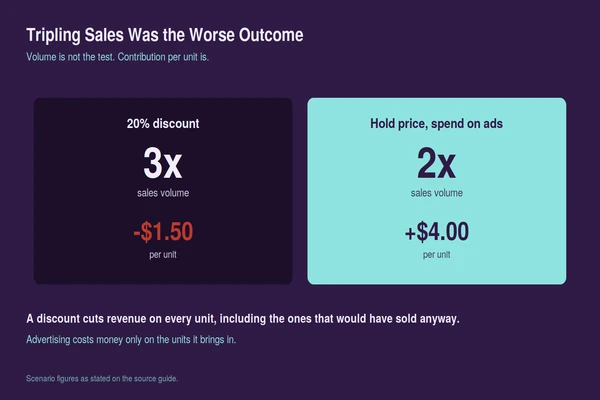
Fewer units, more money. The discount cut revenue on the units that would have sold anyway.
The Fee Sitting On Top of the Discount
Coupons are not just the discount. There is a $0.60 redemption fee, charged each time a coupon is used.
On a $30 product at 10% off, the discount is $3.00 and the coupon costs $3.60. That is a 20% increase in the cost of the promotion, and it lands on redemptions rather than on impressions, so a coupon that performs well costs proportionally more.
One thing does move in your favor. The referral fee is a percentage of the actual sale price, so a discount reduces it. At 15%, a $3.00 discount returns 45 cents of referral fee. Net, the coupon in that example costs $3.15 rather than $3.60, and that offset is worth entering because sellers routinely model the worst case.
It does not rescue the arithmetic. It just makes the arithmetic correct.
How Deep Is Defensible
Depth is a function of what the promotion is for.
5 to 10% on an established product. Enough to move the needle on conversion, shallow enough to survive contact with your margin.
20 to 30% on a new launch, where you are explicitly buying velocity and reviews rather than profit, and where the loss is a budgeted acquisition cost with an end date.
30% and above at Prime Day, which is common and which most sellers should approach as an exposure event rather than a margin event.
The distinction that matters is not the percentage. It is whether you can say what the promotion is buying and when it stops. A launch discount with a defined window is an investment. The same discount still running in month five is a price cut nobody decided on.
The Rule About “Was” Pricing
One thing worth getting right before you set a reference price, because it is a federal rule rather than a marketplace policy.
The FTC’s Guides Against Deceptive Pricing, at 16 CFR § 233.1, address exactly the “was $40, now $28” construction. The rule states that where a former price “is the actual, bona fide price at which the article was offered to the public on a regular basis for a reasonably substantial period of time, it provides a legitimate basis for the advertising of a price comparison.”
The part that catches sellers is what follows. A former price is “not necessarily fictitious merely because no sales at the advertised price were made,” but the advertiser “should be especially careful” that the price was “openly and actively offered for sale, for a reasonably substantial period of time, in the recent, regular course of his business, honestly and in good faith.”
In plain terms: you can reference a former price you genuinely offered, even if it did not sell. You cannot invent one, and you cannot list at an inflated price for a weekend in order to discount from it. The guide also notes that a reduction should be “sufficiently large that the consumer, if he knew what it was, would believe that a genuine bargain or saving was being offered,” which rules out the cosmetic one percent.
This is not a technicality to route around. It is the difference between a promotion and a misrepresentation, and the marketplace has its own enforcement on top of it.
Model It Before, Not After
Five inputs, and the model takes ten minutes.
Enter your cost of goods, the current fee stack, the discount depth and the redemption fee. Then enter the volume lift you expect, and be honest about it, because the lift is the input people inflate to make the answer come out.
Then run the same product with the discount at zero and the equivalent spend routed to advertising instead. Compare contribution per unit, not revenue, and not units.
If the discount scenario returns a negative contribution, you are not deciding whether to promote. You are deciding how much to pay for rank, which is a legitimate decision and a completely different one, and it should have a number attached and a date on which it ends.
The Question to Ask Afterwards
When the promotion finishes, one thing is worth checking that almost nobody checks: what the sales rate was in the two weeks after it ended, against the two weeks before it started.
If it returned to baseline, you bought units. If it settled higher, you bought rank and the discount did what a launch discount is supposed to do. Those are different outcomes and the difference is invisible while the promotion is running, which is precisely when everyone decides it worked.
